 |
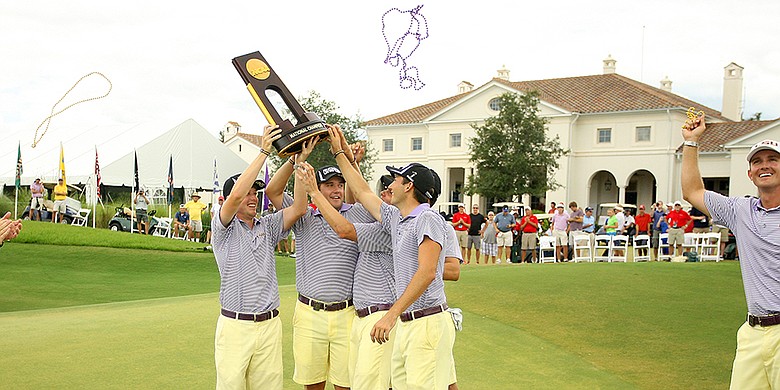
| Louisiana State University celebrates their 2015 NCAA Men's Golf National Championship victory at The Concession in Bradenton, Fla. |
The Road to Becoming a College Golfer
Most college golfers are kids who have been playing the game their entire lives. They've been playing in tournaments since they were little tykes, graduating from the local junior golf associations and on up to regional and state competitions. Some may even play a couple of events on the American Junior Golf Association, considered by many to be the junior golf equivalent to the PGA Tour. Junior golfers use their experience and scores from tournaments at the higher levels of junior golf to prove to college golf coaches that they have the potential to contribute at the college level.While I was fortunate enough to play in one AJGA event as a junior player, my personal path to playing college golf has been less than traditional. I started playing the game as an eager and pudgy three year-old boy in south Florida but didn't play my first real round of golf until I was six and played my first tournament at seven, in which I finished tied for first place; beginner's luck if you ask me.
However, it wasn't until my family moved out to the San Diego area when I was ten that I picked up golf as my primary interest. I started to move away from football and baseball and started playing in tournaments more frequently, but never played particularly well. I was a timid kid who shied away from competition. Eventually, the self-inflicted toll that the competitive aspect of the game gave me caused me to quit the competitive aspect of golf when I was fifteen years old, playing only for my high school varsity golf team and for my personal enjoyment.
After graduating from high school, I chose to go to Florida State University, where both my mother and my father had attended and graduated in the 1980s. I was in the PGA Golf Management program, which trained students how to teach the game and how to run the golf operations at a country club. Being immersed in the game again, I found that I missed the energy of competitive golf. I made the decision to leave Florida State and go back home for a year to work on my game and find a university to play for, knowing that I had matured over the last few years and could cope better with the adversity that every golfer faces at one time or another. My coach back home suggested I take a look at Oklahoma Christian University and the rest is history.
The College Golf Experience
I'm not entirely sure about the amount of work that student-athletes in other sports have to put into their crafts, but I venture to say that practicing golf is one of the most time demanding mainstream college sports. Playing an 18 hole round of golf takes four hours or more to play, while investing an adequate amount of time to every area of the game on the driving range and on and around the practice greens is likely a two hour time investment at minimum. To add, the practice facilities for most sports are on campus while golf's practice facilities (i.e. the golf course) is normally a bit of a drive off campus. Some larger universities own and run golf courses of their own, but those are never on the university campuses themselves.With that however, along with playing the tournament schedule, provides an opportunity to play some fantastic golf courses that aren't necessarily accessible otherwise. Just this year, Oklahoma Christian has had the opportunity to play excellent course designs like Flint Hills outside of Wichita and both courses at TPC San Antonio in San Antonio as well as at private country clubs like Oklahoma City Golf & Country Club and Gaillardia Country Club, both in Oklahoma City. We're blessed to be able to play at two private facilities in Oak Tree Country Club and River Oaks Golf Club on a regular basis.
College golfers, like all other student-athletes, must also deal with missing classes and possibly tests for the sake of traveling and playing in events. They must be very diligent to keep up with their classwork and communicate with professors as to how to make up work and tests they've missed. Some don't cope well with the academic rigor being a student-athlete provides, so many student-athletes take the same classes so that they can review missed material and study for tests together, thus keeping each other accountable for their grades and maintaining their athletic eligibility.
The Tournament Experience
The moment (hopefully) all college golfers work towards is tournament play. Most college tournament teams consist of five players, with the possibility of individual competitors in the tournament to round out the rest of the field. Coaches have their players qualify in an intra-squad tournament of sorts in order to determine who plays in the next tournament. Those qualifying tournaments can be any amount of holes at the discretion of the coach. Exemptions into the team's next tournament are earned through strong performances in preceding tournaments. The top finishers in qualifying are given spots into the next tournament. Some coaches also choose to handpick a player or two to play on the tournament team, for reasons including how the player's game fits the golf course the next tournament is played at.Most college tournaments are played with 36 holes on Monday and 18 holes on Tuesday, with an 18 hole practice round Sunday afternoon. Teams pack up their SUVs or mini-buses and head out for the tournament either Saturday afternoon or Sunday morning, dependent on how far the university is from the hosting golf course. Teams from far enough away will fly into town on Saturday. Some players sleep on the way to the tournament while others choose to listen to music and/or do homework. Practice rounds are a very slow ordeal, with teams often playing groups of five or more and hitting numerous shots around the greens or putts on the greens. Once the practice rounds are over, the team goes out to dinner, conducts a team meeting, and then its off to bed.
The tournament itself starts early Monday morning. The practice areas are flooded with players warming up before the morning round while coaches get their players' scorecards and load up the coach's cart with snacks and drinks for their players. Some coaches are very hands-on in course management and team strategy, walking with their players during the course of play, while others are laissez-faire and trust the preparation their players put in. After the conclusion of play early Tuesday afternoon, the awards ceremony is given honoring the winning team and top individual performers, with the teams heading home immediately after.
Playing college golf has been an incredibly rewarding experience for me as it is for most college golfers and has greatly enhanced my overall college experience. It is a unique experience in the realm of college athletics in that your fellow students often don't watch tournaments due to the time consuming nature of the game, but is fun nonetheless.
For college tournament schedules as well as team rankings, visit Golfstat.
To learn more about college golf and what it takes to get there, click here.

